Why This Print Job Gets More Scrutiny Than Most
Most printed material gets glanced at once. An annual report or company profile book gets handed to a board member, an investor, or a prospective client who will sit with it for several minutes and judge the company partly by how it feels in their hands. That's a different bar than a flyer or a brochure — the physical production choices carry real weight here, not just the content and design.
Binding: Case-Bound vs Perfect-Bound
The binding method is the first real decision, and it depends on who the report is for and how many copies you need.
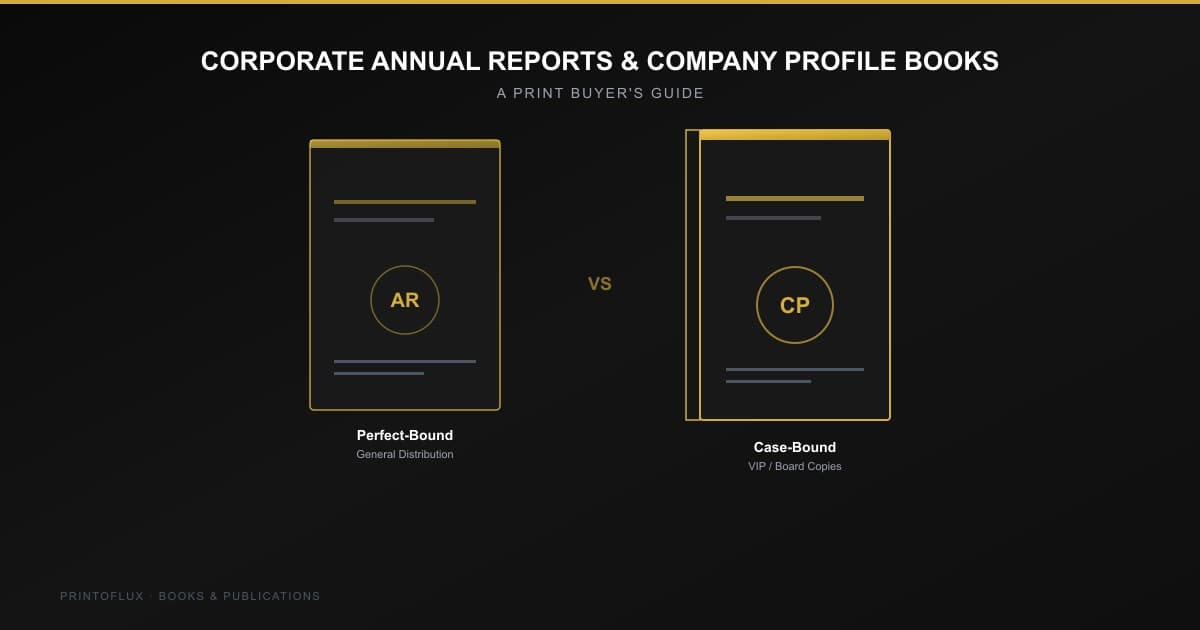
Perfect binding glues the page block to a flat spine under a flexible cover. It's the standard choice for annual reports distributed broadly — to all shareholders, at a general meeting, or bulk-mailed — where quantity and turnaround matter more than the report living on a shelf for a decade.
Case binding (hardcover) sews or glues the page block into a separate unit before wrapping it in rigid board. This is the right call for a smaller run intended for VIP distribution — board members, key investors, an award submission — where the report itself is meant to signal permanence and investment, not just convey numbers.
Many companies split the run: a modest hardcover batch for VIP recipients, perfect-bound copies for general distribution. That's a legitimate way to control cost without compromising on the copies that matter most.
Paper: Interior Stock vs Cover Stock
These are chosen for different reasons and shouldn't be treated as a single decision.
Interior stock carries the financial statements, charts, and narrative pages. A silk or matte-coated stock in the 130-170gsm range is standard — heavy enough to prevent show-through from ink on the reverse side, light enough that a 60-100 page report doesn't become unwieldy.
Cover stock is chosen for durability and finish rather than readability. A heavier board (250-350gsm) laminated matte or gloss is typical, and this is usually where finishing techniques — foil stamping the company name, spot UV on the logo — are applied, since the cover is what people see before they open the report at all.
Finishing Choices That Actually Matter Here
Not every finish is worth the added cost on every job, but a few consistently pay off on corporate reports specifically:
- Foil stamping the company name or logo on the cover reads as deliberate investment, especially in gold or a brand-matched metallic — see our guide to hot foil stamping finishes for the full range of options.
- Spot UV over a logo or key figure on the cover adds a subtle tactile and visual highlight without the cost of full foiling.
- Matte lamination on the cover feels more premium than gloss for this specific document type — gloss reads as commercial/promotional, matte reads as considered and formal, which matches the tone most annual reports are going for.
Page Count and Section Planning
Annual reports typically follow a fixed structure — chairman's statement, financial highlights, audited statements, corporate governance, sustainability section — and the page count usually lands as a multiple of 4 or 8 naturally because of how sections build up. If yours doesn't, it's worth confirming the final layout with your printer before the design is fully locked, since adjusting page count after design (to fit imposition requirements) can mean redesigning spreads rather than just adding a blank page.
What to Bring to the First Conversation
Getting an accurate quote and realistic timeline depends on a few decisions being made early:
- Total quantity and any VIP-copy split (e.g., 500 perfect-bound + 30 hardcover for board members)
- Page count, even if approximate at the quoting stage
- Binding preference, if you already have one — otherwise your printer can recommend based on quantity and use case
- Distribution timeline — annual reports are often tied to a fixed AGM date, and case-bound copies need more lead time than perfect-bound
Working on this year's annual report or company profile book? Browse our book & publication range or request a quote with your page count, quantity, and target date, and our production team will recommend the binding and finish that fits both your budget and your audience.