More Than "Send Us the PDF"
Book printing looks simple from the outside — hand over a file, get back finished copies. In practice, a manuscript goes through several distinct stages before it's a bound book, and skipping the planning at any one of them is where most delays and reprints come from. Here's what actually happens between a finished manuscript and a stack of finished copies.
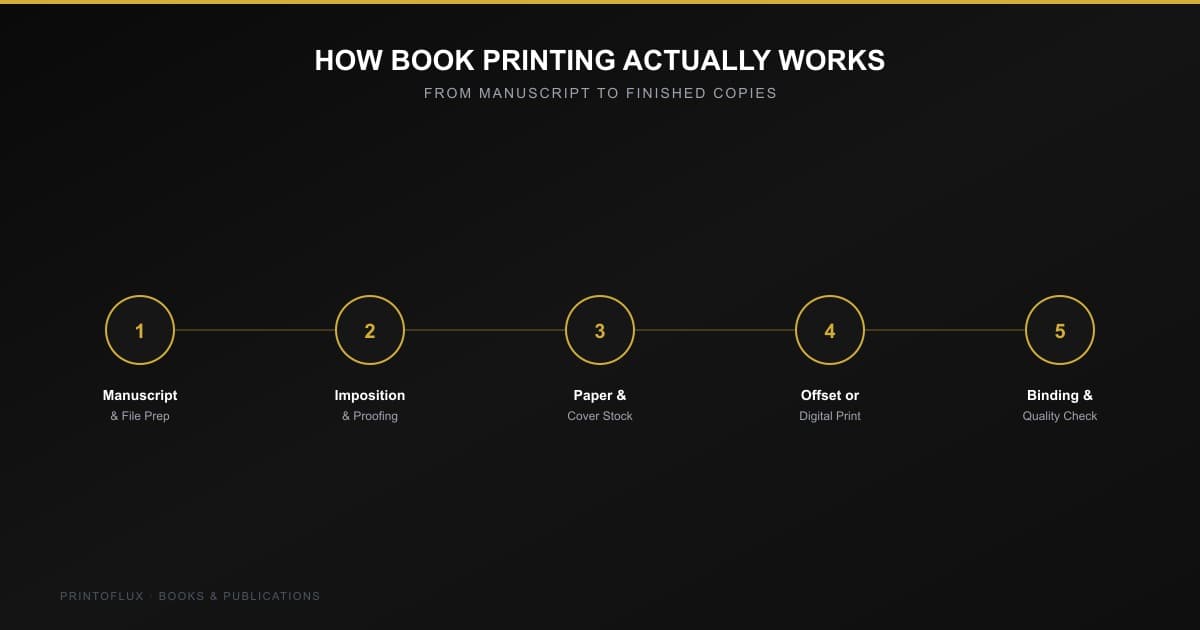
1. File Prep and Page Count Planning
Before anything goes near a press, the file needs to match the binding method it's headed for. Saddle-stitched booklets need a page count divisible by four, since pages are printed and folded in multiples of four regardless of how many pages the manuscript itself has — a manuscript that lands on an odd number needs blank pages added deliberately, not discovered as a problem at imposition. Perfect-bound and case-bound books have more flexibility on page count, but still need the trim size and margins fixed before layout, since changing trim size after design is essentially a redesign.
2. Imposition: Arranging Pages for the Press
Pages aren't printed in reading order. Imposition is the process of arranging pages onto a press sheet so that once printed, folded, and cut, they land back in the correct sequence — a 16-page section might be arranged as four sheets with pages in an order that looks scrambled until it's folded. This is software-driven today, but it's still where page-count and margin problems from step one actually surface, which is why catching them earlier is cheaper than catching them here.
3. Choosing Paper and Cover Stock
Interior paper and cover stock are decided separately, and for different reasons. Interior stock is chosen for readability and bulk — a heavier GSM makes a thin book feel more substantial but adds cost and shipping weight, while too light a stock can show show-through from the printing on the reverse side. Cover stock is chosen for durability and finish — a softcover typically uses a heavier card stock than the interior, while hardcover uses rigid board wrapped in cloth, leatherette, or PU leather.
4. Printing: Offset or Digital, Based on Volume
The press choice comes down to run length, not perceived quality — both processes produce excellent results. Offset uses plates and has a setup cost, but the per-unit price drops sharply at volume, making it the standard choice for larger book runs. Digital skips plate-making, which makes it faster and more economical for shorter runs, proofs, or personalised editions. (We've written about this trade-off in more detail in Offset vs Digital Printing.)
5. Binding and Finishing
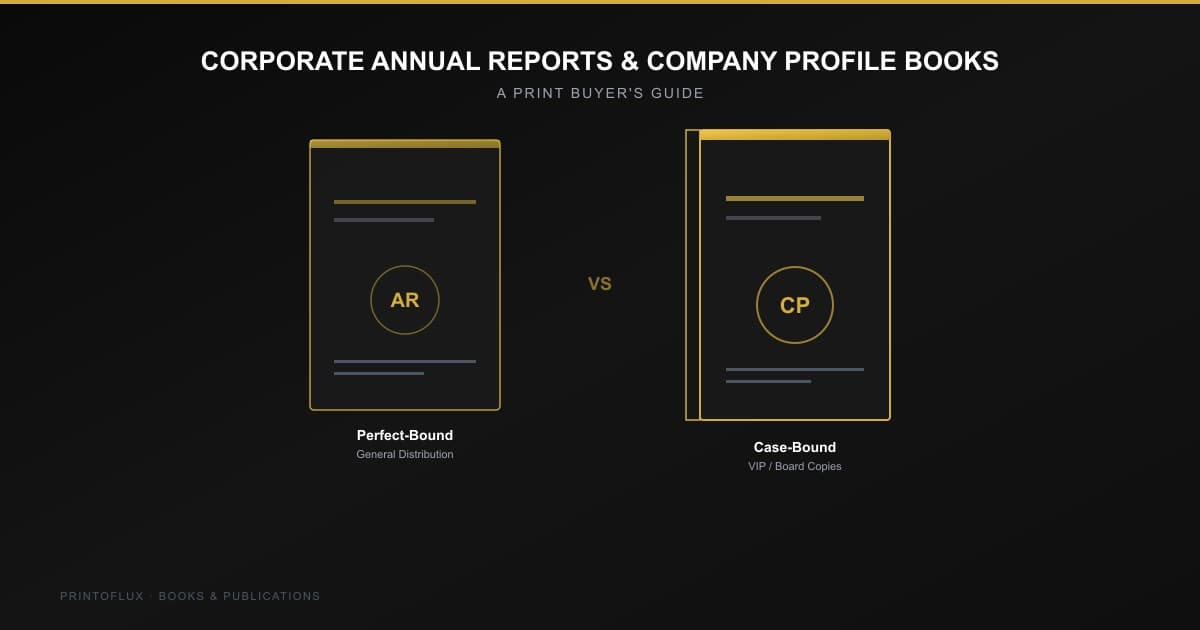
This is where the book becomes a book rather than a stack of printed sheets. Saddle stitching staples folded sections through the spine — fast and economical, but limited to roughly 64 pages before the spine gets too thick to fold cleanly. Perfect binding glues pages to a flat spine, handling far more pages with a more premium, book-like feel. Case binding sews the page block and wraps it in a rigid board cover, built for books meant to last years of handling. (The full comparison is in Saddle Stitch vs Perfect Bound vs Spiral.)
6. Quality Check and Delivery
Before copies ship, finished books get checked for the things a digital proof can't fully show — spine alignment, page trim accuracy, and binding integrity under normal handling. For larger runs, this is a sampling process across the print run rather than a single check, since a binding issue that appears on copy 400 of 2,000 needs to be caught before the whole run ships, not after a customer opens one.
Why This Sequence Matters
Every stage depends on decisions made in the one before it — page count affects imposition, paper choice affects binding method, binding method affects turnaround. Bringing page count, binding preference, and quantity to the first conversation, rather than deciding them one at a time, is what keeps a book project moving in one direction instead of back and forth on revisions.
Working on a book, booklet, or catalogue and not sure where to start? Browse our book & publication range or request a quote with your manuscript's page count and quantity, and our production team will recommend the right paper, binding, and press for the job.