What RSC Actually Means
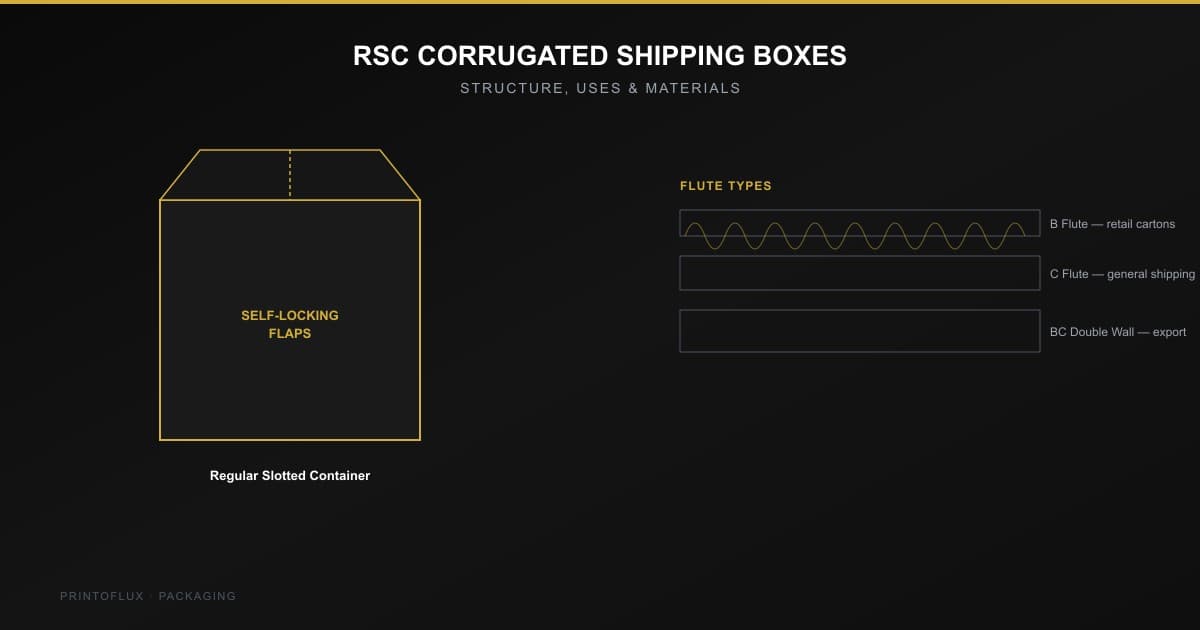
RSC — Regular Slotted Container — is the most common corrugated box style in the world, and almost certainly the shape you picture when you think "cardboard box." It's built from a single corrugated sheet: four side panels joined by a manufacturer's joint, with four flaps at the top and four at the bottom. When closed, the two longer flaps meet edge-to-edge at the centre while the two shorter flaps fold in beneath them — a self-locking structure that needs only tape or glue along the centre seam to close securely.
Why It's the Default for Shipping
Structural efficiency. The flute layer inside corrugated board (a wavy inner liner sandwiched between two flat liners) gives RSC boxes real compression strength relative to their weight — they're designed to stack and survive freight handling, not just look presentable.
Universal compatibility. RSC is a recognised industry standard, meaning box-making machinery, packing lines, and freight/logistics handling are all built around its dimensions and behaviour — there's no re-engineering needed to fit it into existing supply chains.
Cost-effective at scale. A single flat blank, minimal assembly (four folds and tape), and efficient sheet utilisation make RSC the lowest-cost-per-unit option for pure shipping/protection purposes, as opposed to retail-facing packaging where branding drives more of the material choice.
What It's Made Of: Choosing a Flute
Corrugated board is graded by flute type, which determines thickness and cushioning:
- B Flute — thinner, good crush resistance, common for retail-ready shipping cartons and point-of-sale display boxes where a slimmer profile matters.
- C Flute — the general-purpose default for most shipping cartons — a balance of strength and stacking stability for standard freight.
- E Flute — very thin, used more for product packaging that needs some rigidity without shipping-carton bulk (subscription boxes, retail inserts).
- Double Wall (BC) — two flute layers combined, used for heavier goods, export shipments, or long-transit freight where single-wall strength isn't enough.
The right choice depends on product weight, transit distance, and stacking requirements — not a one-size answer, which is why this is worth confirming with your printer against your actual product before finalising a production order.
When RSC Isn't the Right Structure
RSC is built for protection and shipping efficiency, not retail presentation — it's rarely the outer box a customer unboxes in a branded experience (though branded RSC mailers for e-commerce are increasingly common with strong external printing). For retail shelf presence, a tuck-end carton or, for premium positioning, a rigid box is the more appropriate structure.
Getting the Dieline Right
RSC blank size depends on your box's inner length, width, and height, plus the manufacturer's joint and flap depth (conventionally half the box width, so opposing flaps meet cleanly at the centre). Our Box Dieline Calculator works out the flat sheet size directly from your dimensions — or request a quote with your product weight and shipping requirements for a flute recommendation alongside pricing.