The Real Question Isn't Which Looks Nicer
Hardcover and softcover aren't a "premium vs budget" choice — they solve genuinely different problems. A book that will be read once and shelved needs different things from one that will be handled daily for years, or given as a keepsake. Getting this decision right before the design stage avoids a costly rebind later.
Softcover: Built for Volume and Turnaround
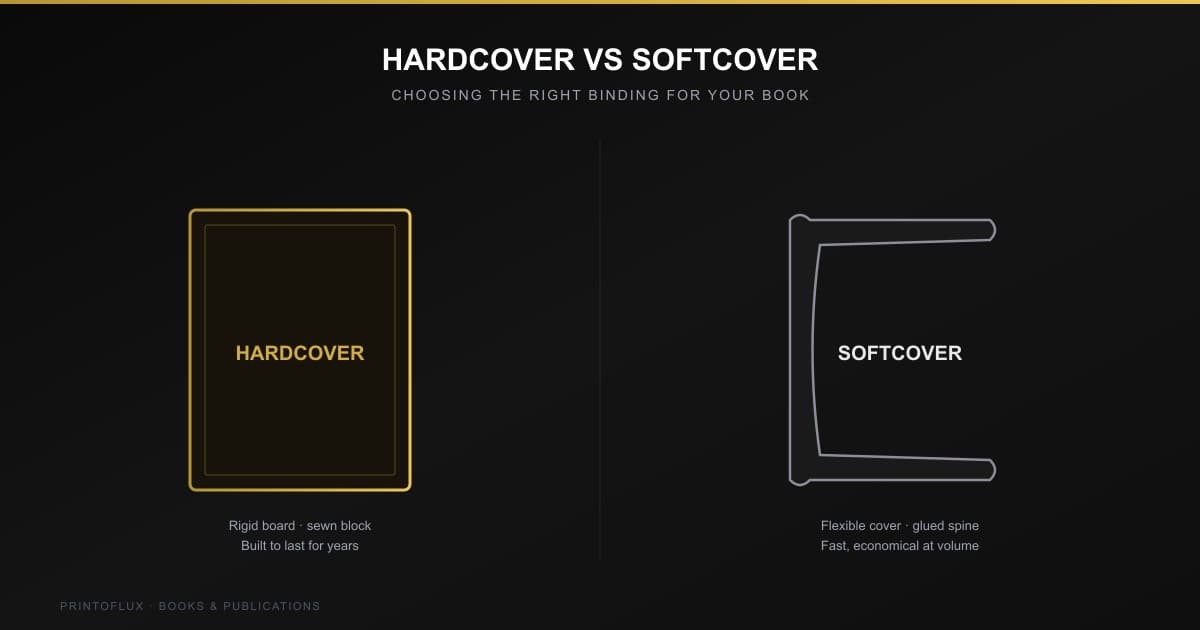
Softcover books use a flexible paper or card cover, bound either by saddle stitching (stapled through the fold, for shorter page counts) or perfect binding (glued to a flat spine, for thicker books). The cover flexes with the page block instead of standing rigid around it.
Softcover is the right call when:
- The book will be read once or occasionally, not handled daily for years
- Cost per unit and turnaround time matter more than shelf presence
- You're printing a larger quantity — cost scales down more efficiently than hardcover
- Examples: catalogues, training manuals, annual reports for internal circulation, workbooks
Hardcover: Built to Last and to Impress
Hardcover (case-bound) books wrap rigid greyboard in cloth, leatherette, Rexine, or PU leather, with the page block sewn or glued in as a separate unit before being cased into the cover. That rigid board is what gives a hardcover book its weight, its resistance to bending, and the sense of permanence it has on a shelf.
Hardcover is the right call when:
- The book is meant to be kept, not discarded after one read — a keepsake, an archive copy, a gift
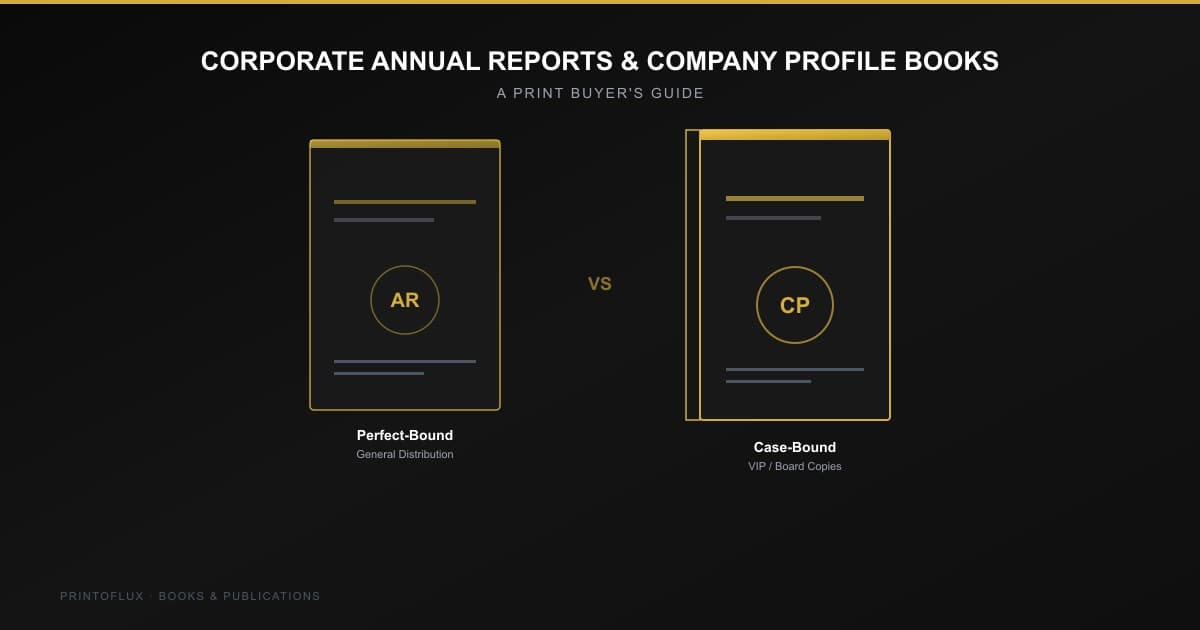
- It represents the brand at a level where perceived quality matters — an investor-facing annual report, a corporate history, a leadership gift
- It needs to survive years of repeated handling — a school textbook reprinted for a decade, a reference volume kept on a desk
- Examples: coffee-table books, corporate annual reports for VIP distribution, photo books, archival publications
The Cost and Timeline Trade-Off
Hardcover isn't just "hardcover instead of softcover" — it's a genuinely different production path. Case binding requires the page block to be sewn or glued as its own unit, then wrapped separately, which adds both cost per unit and lead time compared to a softcover run straight off the same press. For a time-sensitive print run in the hundreds or low thousands, that difference is worth planning around rather than discovering at the quote stage.
Softcover's economics work the other way: unit cost drops more efficiently at higher quantities, and turnaround stays close to standard binding timelines, since perfect binding and saddle stitching are both faster finishing processes than casing in a hardcover.
A Quick Way to Decide
Ask two questions before choosing:
- Will this book still be in someone's hands in five years? If yes, hardcover's durability pays for itself.
- Does the book need to make a strong first impression before anyone reads a page? A gift, an award submission, or a flagship report often needs the physical weight hardcover provides.
If the honest answer to both is no, softcover is very likely the more sensible choice — not a compromise, just the format actually built for that job.
Not sure which fits your project? Our production team can walk through page count, quantity, and end use against both options — browse our book & publication range or request a quote with your specifications to get a recommendation alongside pricing.